
Cloud ERP for Manufacturing: What Modern Manufacturers Should Really Look For
- sabineknoll3
- Jun 23
- 4 min read
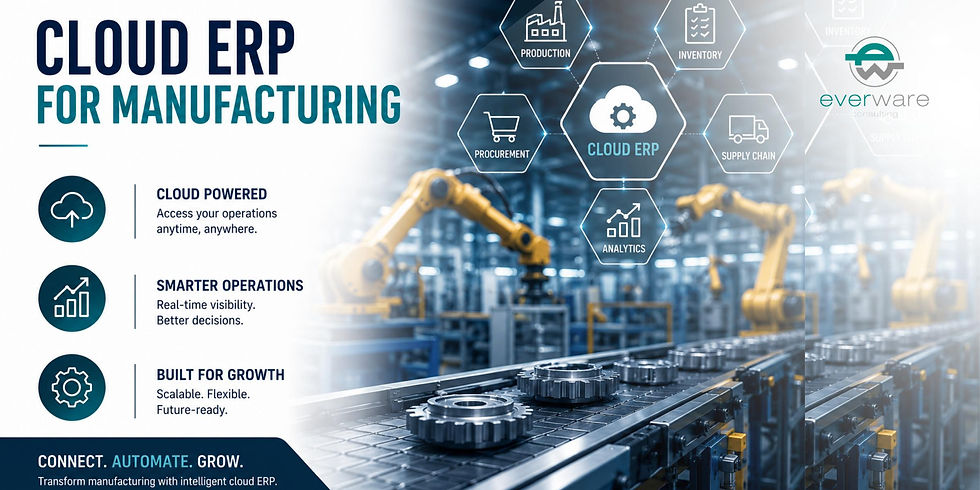
Many manufacturing businesses are still unsure whether they truly need an ERP system.
Some believe:
manufacturing operations can still be managed manually
spreadsheets are “good enough”
ERP systems are only for large enterprises
digital transformation is too expensive or too complex
And for years, many manufacturers continued operating with disconnected systems, manual workflows, and traditional operational processes. But manufacturing today is changing rapidly. Production environments are becoming more connected. Supply chains are more unpredictable.
Manufacturing operations today are more connected, fast-moving, and complex than ever before.
Inventory changes in real time.
Supply chains shift constantly.
Production planning depends on accurate operational visibility.
And customer expectations continue to increase.
Yet many manufacturers still rely on disconnected systems, manual processes, and outdated ERP environments that struggle to support modern operations.
This is why more organizations are moving toward cloud-based ERP systems.
But adopting cloud ERP is no longer just about “moving to the cloud.”
It’s about building operations that are:
Connected
Scalable
Visible
Intelligent
Future-ready
Especially in manufacturing environments where operational delays can quickly impact production, fulfillment, procurement, and profitability.
What Is Cloud ERP for Manufacturing?
Cloud ERP for manufacturing is an enterprise resource planning system hosted on cloud infrastructure that helps manufacturers manage operations from a centralized and connected platform. Unlike traditional on-premises systems, cloud ERP enables businesses to access operational data, workflows, and business processes in real time across locations and departments.
Modern manufacturing ERP systems typically support:
production planning
inventory management
procurement
warehouse operations
supply chain visibility
finance operations
quality management
reporting and analytics
Platforms like Dynamics 365 Finance and Supply Chain Management are increasingly helping manufacturers move toward more connected and intelligent operations.
The goal is no longer just process management.
It’s operational visibility and agility.
Why Manufacturers Need Cloud-Based ERP
Manufacturing environments are evolving rapidly.
And traditional systems often struggle to keep up with:
changing supply chain conditions
multi-location operations
increasing operational complexity
demand forecasting
real-time inventory expectations
This creates operational bottlenecks that impact both efficiency and customer experience.
Cloud ERP helps manufacturers improve:
Operational flexibility
Process visibility
Scalability
Remote accessibility
Cross-functional collaboration
Most importantly, cloud ERP enables manufacturers to make faster operational decisions using connected, real-time data.
Without this visibility, teams often rely on:
spreadsheets
manual coordination
disconnected systems
delayed reporting
And that slows operations significantly.
Core Features to Look For
Not all cloud ERP systems are designed equally for manufacturing operations.
Modern manufacturers should focus on platforms that support both operational execution and long-term scalability.
1. Real-Time Operational Visibility
Manufacturers need visibility into:
inventory movement
production status
order fulfillment
procurement workflows
operational bottlenecks
Real-time visibility improves faster decision-making and reduces delays.
2. Workflow Automation & Orchestration
Automation alone is no longer enough.
Modern ERP systems should support:
connected workflows
dependency-aware execution
intelligent process orchestration
exception monitoring
This becomes especially important in manufacturing environments where one delayed process can impact multiple operational stages.
3. Scalability
As manufacturing operations grow, ERP systems should adapt without creating operational friction.
Scalable cloud ERP platforms help organizations support:
multiple warehouses
growing transaction volumes
international operations
additional workflows
future integrations
4. Integration Capabilities
Manufacturing operations depend on connected systems.
ERP platforms should integrate smoothly with:
e-commerce systems
POS platforms
warehouse systems
logistics tools
reporting platforms
Disconnected systems create disconnected operations.
5. User-Friendly Experience
One of the biggest ERP adoption challenges is usability.
Employees often resist systems that feel:
overly complex
rigid
difficult to navigate
Modern ERP environments should support:
low-code flexibility
simplified workflows
business-user-friendly operations
Because operational adoption matters just as much as technical implementation.
Choosing the Right Cloud ERP
Selecting the right cloud ERP isn’t just a technology decision. It’s an operational strategy decision.
Manufacturers should evaluate:
Operational complexity
Future scalability
Workflow flexibility
Integration needs
Visibility requirements
Automation maturity
The best ERP systems are not necessarily the ones with the most features. They are the ones that help businesses operate more efficiently, intelligently, and visibly.
Organizations are increasingly shifting toward ERP environments that combine:
automation
orchestration
operational intelligence
real-time visibility
Because manufacturing success today depends on how quickly businesses can adapt and respond to operational change. For larger manufacturing enterprises with complex supply chain operations, Microsoft Dynamics 365 Finance & Supply Chain Management provides advanced operational capabilities and enterprise-level process management.
For small and mid-sized businesses looking for flexibility and scalability, Microsoft Dynamics 365 Business Central offers a powerful cloud ERP foundation that supports operational growth without unnecessary complexity.
Why ERP Consulting Matters
Technology alone does not guarantee operational success.
Successful ERP implementation depends heavily on:
process understanding
workflow optimization
operational alignment
user adoption
long-term scalability planning
Everware helps manufacturing businesses build ERP environments that are not only technically strong but operationally intelligent.
Our consulting approach focuses on:
operational efficiency
workflow optimization
process visibility
scalable ERP architecture
connected business operations
Whether businesses are implementing Microsoft Dynamics 365 FSCM or Business Central, the goal is always the same:
Helping organizations operate smarter, faster, and with greater visibility.
Final Thoughts
Cloud ERP is becoming a critical foundation for modern manufacturing operations.
But the future of manufacturing ERP is not just about digitization.
It’s about creating:
connected operations
intelligent workflows
operational visibility
scalable execution environments
As manufacturing complexity continues to grow, businesses need ERP systems that help operations move faster—not systems that create more friction.
At everware, we believe modern ERP environments should support smarter, more connected manufacturing operations built for long-term scalability and operational agility.


Comments